NDIS Mental Health Support: How Mentoring Helps Participants Thrive
October is Mental Health Month. Most of the messages you will see are about checking in and asking "are you OK?". That matters. But if you are the parent of a teen or young adult with a disability, you probably want something more practical.
What does good mental health support look like on an ordinary Tuesday? When the bus is late, the plan falls through, or the gym is shut?
At Quest Collective, our answer starts with one of our Six Pillars: Mindset. Here is what it means, what it is not, and five things to look for in any NDIS mental health support your family is weighing up.
First, what mentoring is not
Mentoring is not therapy. It does not replace a psychologist, GP, psychiatrist or crisis service. If your son or daughter has a clinical team, that team stays in charge of clinical care.
A mentor does something different. A mentor is there for the ordinary hours of the week. Those are the hours where hard days actually happen. It is where new tools get practised, and where they either stick or fade.
Mindset: tools for hard days
Quest works to six pillars: Mateship, Movement, Mindset, Meaning, Mastery and Mission. Every hour of our support goes on one of them, pointed at a goal the participant chose.
In plain words, Mindset means tools for hard days. It is how someone talks to themselves when things go wrong, and what they do next.
The big idea is simple. Tools are practised on calm days, so they are there on hard ones. Nobody learns a new way to handle frustration in the middle of a bad moment.
So our mentors focus on two things:
Naming what happened, without judgement.
Rehearsing the next-time plan while things are calm.
They also deliberately step back from one thing: smoothing every obstacle before the person meets it. If a mentor removes every bump, the person never finds out they can handle one.
What does progress look like after six months? Shorter recovery from setbacks. Words for what they are feeling. One or two strategies they reach for themselves, without being prompted.
Mental health is built across the whole week
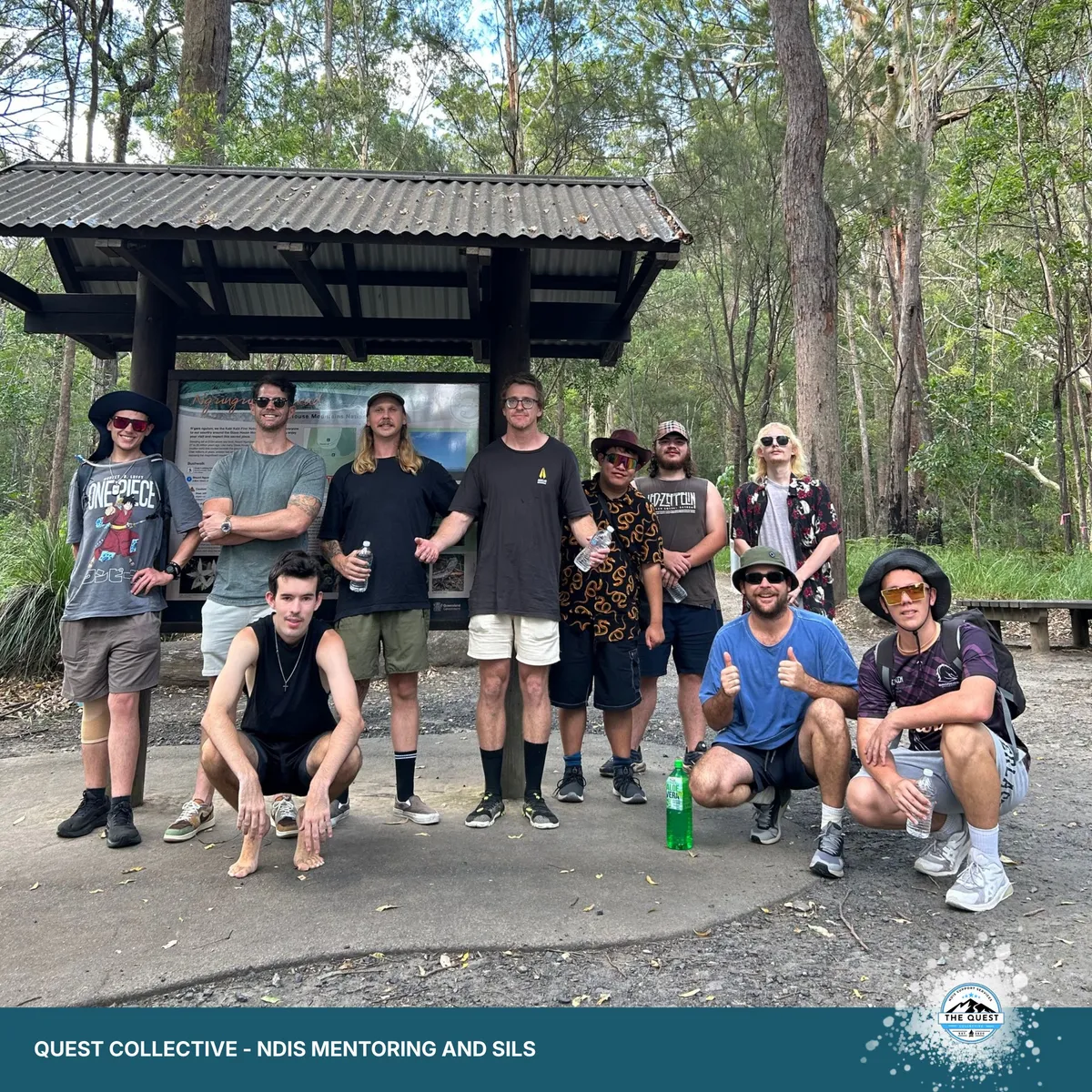
Mindset does not work on its own. Movement gives people a body that backs them. Mateship gives them people to belong to. Meaning gives them a reason to get up in the morning. That is why our mentoring includes group days and community, like our Monday men's group, alongside one to one time. The aim is a world that gets bigger, not just busier.
5 things to look for in mental-health-aware NDIS support
The same faces, week after week. Trust comes first. A revolving door of support workers means starting from zero every shift. At Quest, one to three dedicated mentors are matched to one participant and stay consistent. Ask any provider: who will actually turn up, and will it be the same people next month?
Enough hours for something to change. New habits need repetition. Our mentoring minimum is 15 hours a week, and we say no under that. Below 15 hours, sessions become visits and nothing compounds. Ask: how many hours does this provider think it takes to build a routine?
A plan for hard days, made on good days. Ask how the team prepares for a bad day, not just how they react to one. If the answer is "we'll handle it when it happens", ask again.
Activity with a purpose. At Quest, passive babysitting is the named enemy. Drives to nowhere and staff scrolling their phones do nothing for anyone's mental health. Ask: what was last week's session actually for?
Someone who owns it, and a review you are part of. You should know who to call, and you should hear from them. At Quest, Dan (our founder) and Bek (our CEO) sign off every match. They also sit in on the 90-day review with the participant, the family or nominee, and the support coordinator. If a pillar is not moving, we say so and change what we are doing.
What this can look like
A seventeen year old has stopped leaving the house. Fifteen hours a week begins with a gym session and a coffee, with the same mentors on the same days. By week four, he is asking when the next group day is. By day 90, he has a training routine he owns, two mates outside his family, and a goal about work that is his idea, not his mum's.
Illustrative scenario only. Does not describe a real participant.
The same pillars, wherever someone lives
The Six Pillars run through all our support, including Supported Independent Living (SIL) and our ILO-informed model for people living in their own home. If your family is also thinking about the next step, like moving out of the family home, Carla can talk that through with you too.
Talk to Carla
Quest mentoring is available across the Sunshine Coast for teens and adults, from 15 hours a week. The first step is a no-pressure conversation with Carla, our Client Intake Officer. Tell her about the person, what they enjoy, and what has not worked before.
Book a free discovery call with us or call us at 0468 406 815. You may also visit our website: www. questcollective.org
Quest Collective is a mentor-led provider on the Sunshine Coast, operating to the NDIS Practice Standards.
If you or someone you support is in crisis or in danger, call 000. For 24/7 crisis support, call Lifeline on 13 11 14.